About the Piece
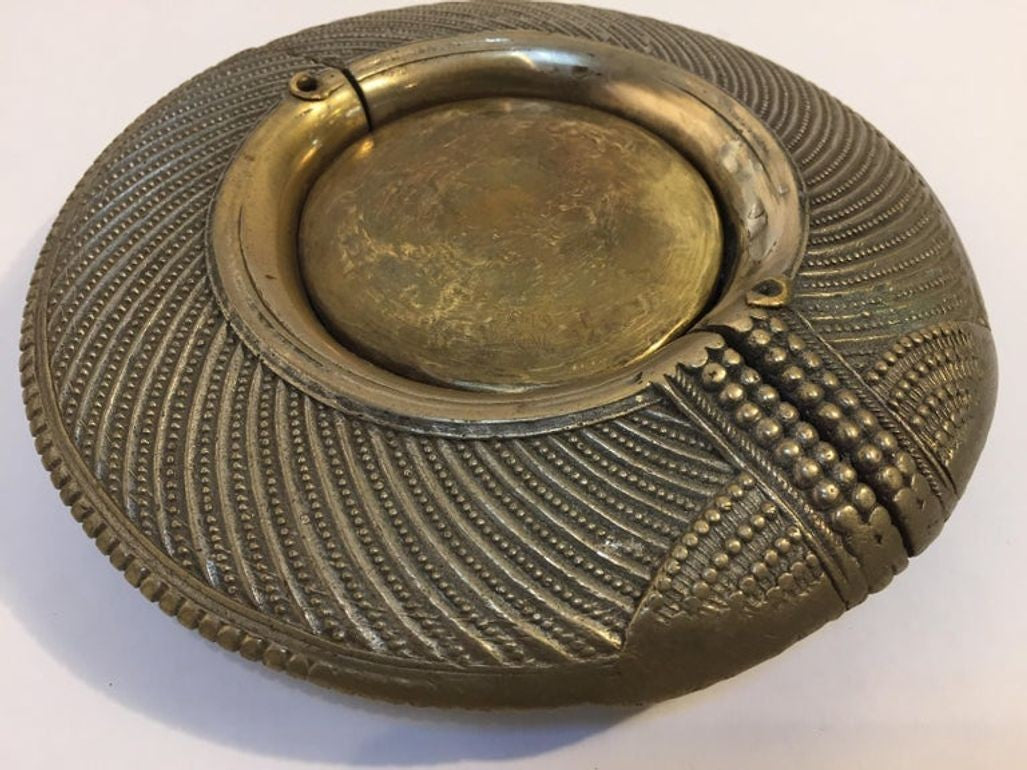
An unusual and highly decorative antique Indian Dhokra brass ankle bracelet, dating to the early 20th century and later thoughtfully repurposed as a small catchall or vide-poche. Originally created as a substantial traditional ankle ornament, the piece is formed as a broad, hollow circular band of heavy brass. Its surface is richly articulated with repeating chevron, geometric and granulated decoration, giving the object the distinctive tactile quality associated with traditional Indian tribal metalwork. The original bracelet construction remains visible, including the former closure area and push-pin mechanism, which has subsequently been secured. At a later date, a circular brass plate was fitted within the center opening, transforming the wearable ornament into a functional decorative vessel. It may have originally been adapted for use as a small ashtray, although today it is particularly compelling as a vide-poche, jewelry catchall, desk accessory or sculptural collector's object. The piece relates to the celebrated metalworking traditions commonly known as Dhokra or Dokra, an ancient form of non-ferrous metal casting practiced by artisan communities in eastern and central India. Dhokra objects are traditionally associated with the lost-wax casting process, a technique with exceptionally deep roots in the Indian subcontinent. Rather than the formal refinement of courtly Indian metalwork, Dhokra is prized for its expressive surface, geometric ornamentation, hand-worked character and distinctive vernacular aesthetic. This bracelet exemplifies that sensibility through its bold circular silhouette and densely patterned surface. Its later transformation adds another layer to the object's history. Instead of discarding an obsolete piece of traditional jewelry, an earlier owner preserved it by converting it into a useful decorative object—an appealing example of historic adaptation and reuse. The naturally aged brass displays a rich, dark patina with areas of warmer golden metal showing through the raised decoration. Variations, oxidation and irregularities are consistent with its age, handmade manufacture and previous use and contribute considerably to its character. At approximately 7.5 inches in diameter and 1.5 inches high, it has excellent scale for display on a coffee table, library table, desk or console. It would integrate beautifully into an eclectic, Anglo-Indian, tribal, modernist or contemporary collected interior, where its sculptural geometry can be appreciated independently of its original function. A distinctive object for collectors of Indian tribal art, Dhokra metalwork, ethnographic jewelry and unusual decorative objects. India, circa 1920s. Dimensions: Diameter: 7.5 in. (19.05 cm) Height: 1.5 in. (3.81 cm) Condition: Good antique condition with wear consistent with age and use. Naturally aged brass surface with patination, oxidation and expected irregularities. The central brass insert is a later addition made when the original anklet was repurposed as a small vessel. Object: Tribal ankle bracelet / later catchall or vide-poche Origin: India Period: Early 20th Century Date: Circa 1920s Style: Indian Tribal / Folk Art / Anglo-Indian Material: Brass Techniques: Lost-wax casting tradition, hand-crafted, repoussé-style decoration, granulated/geometric ornament Color: Aged brass / dark bronze-gold patina Diameter: 7.5 in. Height: 1.5 in. Condition: Good; wear and patination consistent with age; later central brass insert antique Dhokra brass, Dhokra art India, antique Indian tribal jewelry, Indian brass anklet, tribal ankle bracelet, antique Indian brass, lost wax brass casting, Indian tribal art, ethnographic jewelry, Anglo Indian decorative object, brass vide poche, antique brass catchall, Indian folk art, tribal metalwork, Dokra brass, early 20th century India, sculptural brass object, collectible Indian metalwork