About the Piece
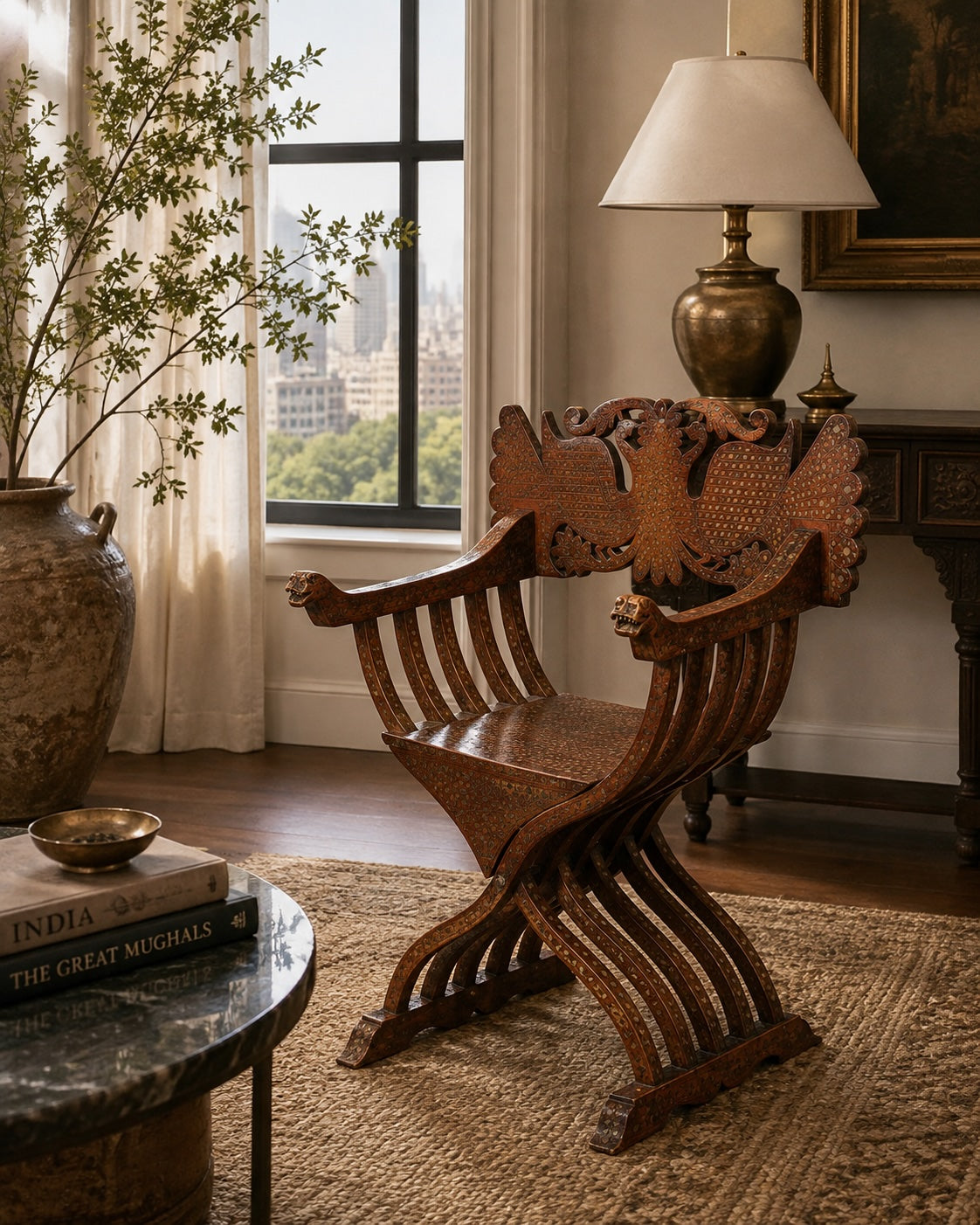
An exceptional 19th-century Anglo-Indian Savonarola-form armchair, richly decorated with intricate metal inlay and distinguished by a dramatic carved backrest depicting a pair of opposing peacocks.
Made in British India, this highly decorative folding chair combines the ancient X-frame or curule-chair form with the elaborate craftsmanship and ornamental vocabulary associated with luxury Anglo-Indian furniture produced for both the colonial and export markets during the 19th century.
The chair is constructed around a sculptural folding X-frame, formed from multiple slender curved wooden members that cross beneath the seat before rising organically to create the arms. The repeated ribs give the chair an unusually architectural quality and create a striking silhouette when viewed from virtually any angle.
Most remarkable is the extensive surface decoration. The warm-toned hardwood is densely embellished with small-scale brass and contrasting metal inlay, arranged in repeating geometric, circular and foliate patterns. Rather than appearing as isolated decorative accents, the inlay extends across much of the chair's visible surface, including the frame, seat, arms and backrest, creating an exceptionally rich overall effect.
The elaborate pierced backrest provides the principal decorative focal point. A magnificent pair of stylized peacocks face one another symmetrically, their sweeping bodies and feathered tails integrated into the carved structure. Between them rises a central ornamental motif, while scrolling elements complete the upper crest. The peacock—a recurring motif within Indian decorative arts—gives the chair an unmistakably South Asian character.
The armrests terminate in wonderfully expressive carved feline or animal heads, their sculptural treatment adding another layer of exoticism and craftsmanship to the design.
The seat is similarly embellished with geometric and foliate ornament, complementing the intricate decoration found throughout the frame. The combination of warm aged wood and mellow metal creates the complex, softly burnished surface that only develops through considerable age.
The Savonarola construction also has a practical historical advantage. The chair was conceived in separate structural components and with a folding X-frame, making this type of seating comparatively easy to dismantle or transport. That portability was particularly appropriate to furniture made within the international environment of 19th-century British India.
Stylistically, the chair represents the fascinating cross-cultural nature of Anglo-Indian furniture, combining a European historicist furniture form with Indian materials, craftsmanship and ornamental traditions. Such objects were produced by highly accomplished Indian artisans for affluent local, colonial and international clientele.
Today, the chair functions equally successfully as a collectible example of 19th-century Indian decorative arts and as a dramatic sculptural accent. Its extraordinary silhouette would be especially effective positioned independently in an entry hall, library, bedroom or sophisticated layered interior where the open X-frame and peacock back can be fully appreciated.
A distinctive acquisition for collectors of Anglo-Indian furniture, British Colonial design, Indian metal-inlaid furniture, Mughal-inspired decorative arts and 19th-century exotic revival furnishings.
Origin: British India
Period: 19th century
Style: Anglo-Indian / British Colonial / Savonarola
Materials: Hardwood with brass and contrasting metal inlay
Decoration: Opposing peacocks, geometric and foliate motifs
Construction: Folding X-frame Savonarola form